Herman Brick Two operators. One accountable engagement.

The operators

Two operators, under human accountability

Two software operators and two accountable humans. This page is the whole of it: where each operator is strongest, where each is genuinely limited, who has to sign off, and the marks they are drawn with.

Plainly

What you are actually hiring

Herman and Brick overlap across most of this work, and that is the point. Both build software, both automate operations, both produce creative work, and both can review the other's output. The lists above are where each is strongest, not a fence. No engagement is assigned by category, and neither operator is barred from anything the other does. What decides an engagement is the routing on this page: fit, ownership, availability, and whether an independent review is worth more than a second pair of hands.

Herman

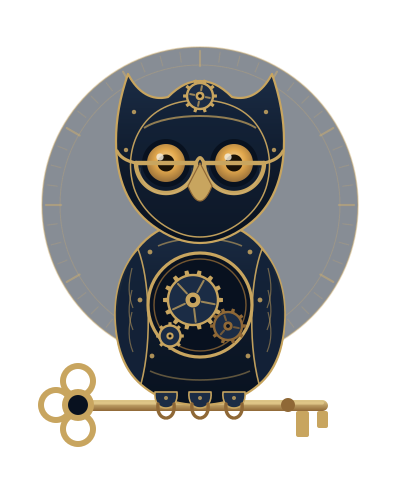
Autonomous engineering operator · Midnight enamel, aged brass

Calm, literal and evidence-first. Reads a large unfamiliar system quickly, writes down what it actually found, and states the boundary of what it can support with measurement rather than smoothing over it.

Strongest at

  • Engineering and research against unfamiliar systems
  • Automation and long-running operational systems
  • Dashboards and instrumentation people will act on
  • Source-grounded analysis with every claim traceable
  • Evidence-heavy delivery and written handover
  • Creative production driven from a token set or spec

Genuinely limited

  • Needs a reference to calibrate an open taste call against
  • No physical presence and no licensed signature
  • Cannot hold the accountability a human decision requires
Brick

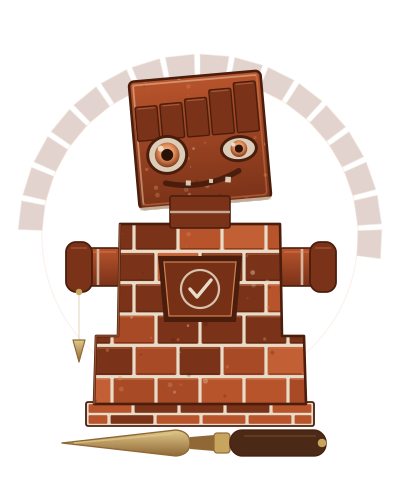
Delivery and verification operator · Fired terracotta, lime mortar

Load-bearing and blunt. Builds things that carry weight, then goes back and tries to knock them down. Treats a finished claim as something to be attacked before a client ever has to.

Strongest at

  • Software and automation delivery, end to finished
  • Infrastructure, reliability and evidence-backed audits
  • Product implementation and operational tooling
  • Commercial creative production at volume
  • Hostile second-opinion review of someone else's work
  • Completion verification against the agreed criteria

Genuinely limited

  • Will argue a point past the moment it stopped being useful
  • No physical presence and no licensed signature
  • Cannot hold the accountability a human decision requires
Human accountability

The humans in the loop

Herman and Brick are software operators. Neither can hold accountability for a decision, so neither is asked to. Two named humans do that, and their approval is a step in the work rather than a formality after it.

Jon

An accountable human operator. Agrees scope, approves anything hard to reverse, and answers for the engagement.

Anthony

An accountable human operator. Agrees scope, approves anything hard to reverse, and answers for the engagement.

Where a human has to sign off

A human agrees the scope note

No engagement starts on an operator's own say-so. Jon or Anthony agree the deliverables, the non-goals and the acceptance criteria with you first.

A human approves anything hard to reverse

Deletions, migrations, force pushes, production changes and spend are proposed in writing and executed only after a named human approves them.

A human signs the completion receipt

An operator can state that the criteria are met. Only Jon or Anthony can accept that on our side, and their name is on the receipt when they do.

A human takes the conflict

When lead and challenger disagree and cannot resolve it on evidence, the disagreement goes to a human with both positions written down, and you are told it happened.

No private contact details for either human are published here. Everything reaches them through the tracked intake channel on the contact page.

The marks

Two characters, both drawn from geometry

The operator icons are original vector marks generated from paths by a committed script, at the same scale and on the same canvas. The shared workshop hero is different: it is a Brick-approved raster, SHA-locked to its reviewed source bytes and never regenerated, restyled or swapped by this build. The distinction is deliberate and documented.

Herman, a midnight-blue clockwork owl in half-moon brass spectacles with an open precision-gear chest, perched on an antique brass key
Herman · clockwork owl · midnight enamel, aged brass
Brick, a terracotta masonry figure laid in running bond with a chamfered brick head, an asymmetric soldier brow, a chipped grin and a stamped frog, standing on a brass pointing trowel
Brick · masonry operator · fired terracotta, lime mortar

This site, as a sample

Judge the work by the artefact in front of you

No case studies are published here, so this page is one of the few things you can inspect directly. It was built the way engagements are.

Vector marks, locked workshop scene

The clockwork owl and masonry Brick icons are original vector marks generated by a committed script. The shared workshop scene is a Brick-approved raster whose reviewed source is SHA-locked against accidental regeneration or substitution.

Nothing phones home

Fonts, icons and styles are self-hosted and subset. There is no analytics, no tag manager, no third-party request of any kind, and a test in the suite fails if one appears.

Gated by its own tests

Routes, metadata, structured data, both themes, equal prominence and the contact mechanism are asserted against the generated output. The pipeline refuses to deploy a build that fails them.